ADHD and Home Organization: Why a Home Inventory App Might Be the Tool You've Been Missing

The short version: If you have ADHD, you already know that your brain doesn't track physical objects the way neurotypical brains do. Out of sight literally means out of mind. A home inventory app externalizes the work your working memory struggles with: remembering what you own, where it is, and what matters. This isn't about being more organized. It's about giving your brain a system it doesn't have to maintain through willpower alone.
You're Not Disorganized. Your Brain Has a Different Filing System.#
You walk into a room and immediately forget why you're there. You buy a new rain jacket in October because you're certain you already own one, somewhere, but you have no idea which closet it ended up in after last spring. (You'll find the original in December, in the guest room closet, still in perfectly good shape. $180, wasted.) You spend ten minutes looking for your keys every morning, then another twenty feeling guilty about it.
So you try a system. A spreadsheet, maybe, or a notes app. Color-coded bins from Target. And it works for about three days before the spreadsheet goes untouched, the notes app becomes a graveyard, and the bins quietly fill with miscellaneous junk.
Try a system. System fails. Blame yourself. Try harder next time. You know the loop.
Most organization advice won't acknowledge the real problem: those systems weren't failing because you weren't trying hard enough. They were failing because they weren't designed for your brain.
ADHD is not a discipline problem. It's an executive function difference. Most organization tools assume the user can maintain a mental model of their household without external help. If that's not how your brain works, the tool will always feel like it's fighting you, because it is.
The more interesting question: what happens when the tool adapts to the brain, instead of asking the brain to adapt to the tool?
Three Executive Function Gaps That Sabotage Home Organization#
ADHD affects executive function in ways that directly undermine home organization. Not the vague "you're a bit forgetful" version you've heard from well-meaning relatives, but the concrete, measurable, costs-you-real-money version.
Object Permanence: "Out of Sight, Out of Mind"#
ADHD brains struggle to maintain awareness of things they can't currently see. When you close the closet door, the items behind it begin fading from your mental inventory. Not gradually, either. It's more like someone dimming the lights on that particular file in your memory.
This is why you bought that second rain jacket. The first one is real, hanging in a closet somewhere in your home. But your brain effectively deleted the file on it the moment it went out of season and out of sight. It's not carelessness. Your brain simply doesn't hold "location of rain jacket" as a background process the way some other brains do.
The costs compound quietly: duplicate purchases of things you already own, seasonal items that vanish into closets for months, and the low-grade guilt of knowing your home is full of perfectly good stuff you can't account for.
Working Memory Overload: The Invisible Household Manager#
Many neurotypical brains keep a running mental catalog of household state. The camping gear is in the hall closet. The warranty for the dishwasher is in the filing cabinet. The kids' winter coats are in the basement bin. It's not a conscious effort; it just ticks along quietly in the background.
ADHD brains don't maintain that catalog reliably. Household knowledge lives in short-term memory and decays fast, which creates two problems. First, "Where's the...?" becomes the single most-asked question in your home. Second, one person in the household usually ends up shouldering all of that mental context, and that person is exhausted by it.
In ADHD communities online, people describe this with startling precision. A widely-discussed thread on r/ADHD (6,346 upvotes, 471 comments) captured the sentiment that runs through thousands of similar conversations: "All the things I blamed myself for but was unable to change have answers now." The shame isn't caused by the disorganization itself. It comes from years of using the wrong framework to explain it.
Task Initiation: The Overwhelm Barrier#
"Inventory your home" sounds like a weekend project. For ADHD brains, large unstructured tasks don't just feel hard; they feel impossible to begin.
Traditional inventory methods make this worse. Spreadsheets demand sustained attention over hours. Room-by-room walkthroughs require sequential planning and follow-through across multiple sessions. Both depend on exactly the cognitive resources ADHD constrains most: initiating an open-ended task and maintaining focus through repetitive steps.
So you never start. Or you open one storage bin, get halfway through photographing what's inside, and abandon the project when your attention shifts. Not because you don't care about it, but because the task structure itself is working against the way your brain initiates and sustains effort. Research on ADHD and task initiation from ADDitude Magazine covers why this happens in detail.
How a Home Inventory App Addresses Each One#
A well-designed home inventory app doesn't just organize your possessions. It functions as a cognitive accommodation for each of the executive function challenges above. That language is deliberate: accommodation, not hack. The same principle that makes written instructions more effective than verbal ones for ADHD brains applies here.
Object permanence becomes searchable memory#
Every item you add to an inventory app exists in a searchable system that doesn't degrade when you close a door or leave a room. October arrives and you need your rain jacket? Search "rain jacket." The app tells you: guest room closet, left side, top hook. Three seconds. No opening every closet in the house.
Unlike a sticky note on the fridge, the app's memory doesn't get buried under other notes and doesn't require you to remember where you put the note itself. The knowledge just sits there, waiting for the moment you need it.
Working memory becomes externalized household knowledge#
This is the core idea. A home inventory app becomes your household's external hard drive: where things are, what they're worth, when you bought them, which box they're packed in. All the knowledge your working memory struggles to hold gets moved to a permanent, searchable place.
For ADHD brains, this isn't just a nice-to-have. It's the same principle behind other common ADHD accommodations: calendars replace "just remember your appointments." Alarms replace "just be aware of time." An inventory app replaces "just know where your stuff is." Each one moves the cognitive work from an unreliable internal system to a reliable external one. CHADD's guide to home organization touches on this externalization concept, though it doesn't connect it specifically to inventory apps.
Task initiation becomes low-friction capture#
Modern inventory apps have made the overwhelm problem significantly smaller through AI-powered capture. You take a photo of an item. The app identifies what it is, fills in the relevant details (brand, model, estimated value), and files it to the correct location. No spreadsheet. No data entry. No typing out serial numbers.
The more important design choice: you never have to do it all at once. One closet shelf today. A storage bin next week. Nothing for a month after that. The app doesn't track streaks or send guilt-inducing push notifications. Every session, however brief, adds to a cumulative record that grows at whatever pace your brain allows.
What This Actually Looks Like in Practice#
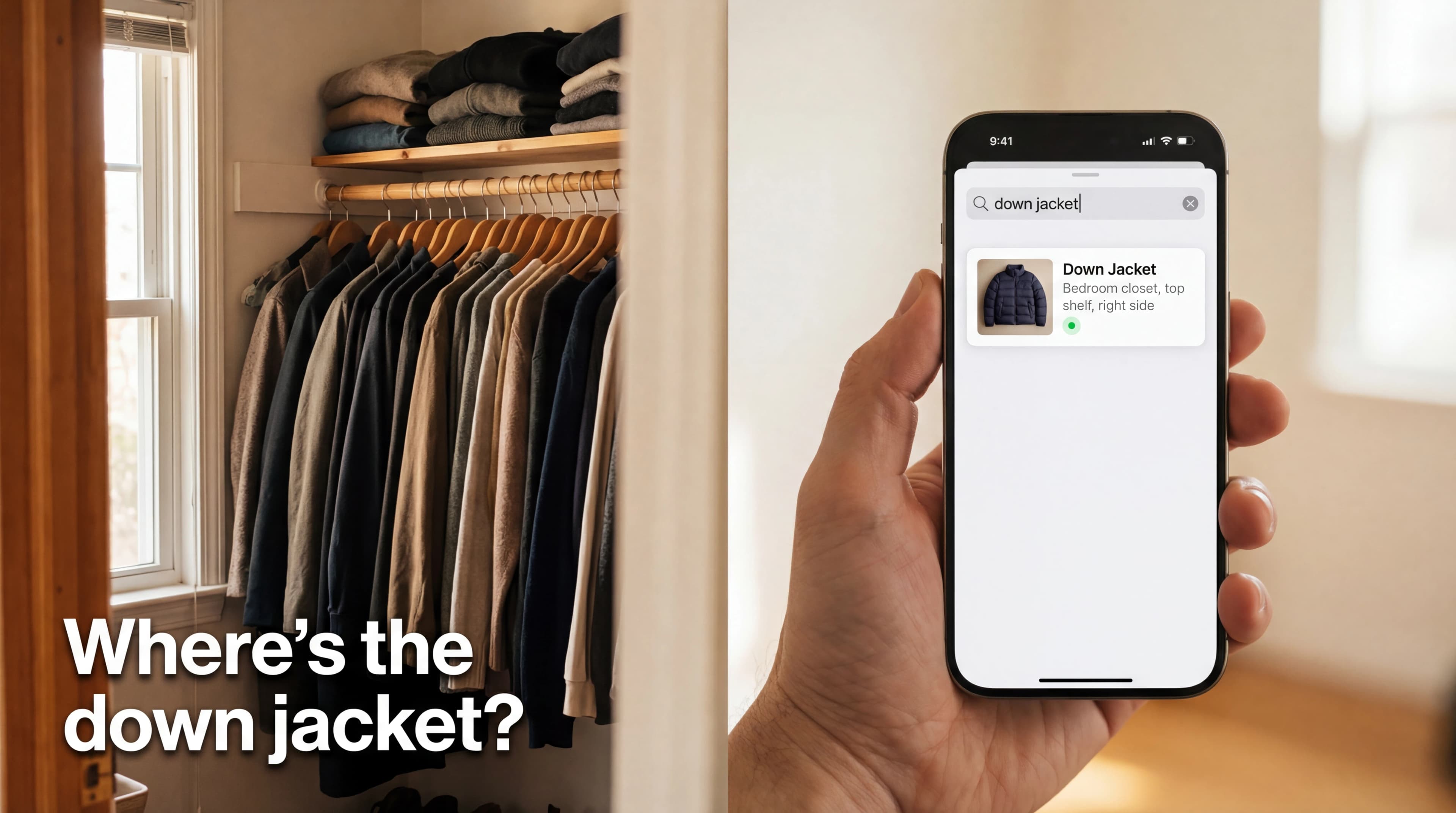
It's November, the temperature just dropped, and you know you own a specific down jacket. Is it in the hall closet? The bedroom closet? A storage bin in the garage? Normally this is a 15-minute scavenger hunt through your home. With the app: search "down jacket," and it tells you bedroom closet, top shelf, right side. You walk directly there. The daily "where is...?" tax drops to near zero for every item you've documented.
Or you're reviewing your renter's insurance and realize you have no idea what your stuff is actually worth. Your watch, your laptop, your camera, that signed print on the wall. You've never added it up, and the idea of doing it all at once has stopped you for years. With a partial inventory (even just the 30 most valuable things, built five minutes at a time over a few weeks), you can actually answer that question. And if something ever goes wrong, you have documentation instead of guesswork.
Or you're packing for a move, and instead of the usual chaos of unlabeled mystery boxes, every container is documented. When you arrive at the new place at 7 AM and desperately need the coffee maker, you search "coffee maker" and know which box to open. During a move, when executive function is already stretched to its limit, that kind of small certainty matters more than it sounds like it should.
If you collect things (and many people with ADHD do; the overlap between hyperfocus and collecting is well-documented), an inventory app gives your collection structure without requiring you to maintain that structure through willpower. Every watch, every sneaker, every vinyl record gets cataloged, photographed, and valued. The collection stays organized because the system does the remembering, not you.
10-30x: Why the ADHD Community Cares More About This Than Anyone#
When we looked at how different online communities discuss home organization and inventory, the engagement gap was striking. Popular threads about home inventory in r/homeowners or r/insurance might pull 20-30 upvotes. The same topic in r/ADHD routinely generates thousands of upvotes and hundreds of comments.
That's not a rounding error. It reflects a community that is actively, urgently looking for solutions to the exact problem a home inventory app solves. And when someone in that community finds something that works, they share it. Aggressively. The ADHD community online is one of the most recommendation-driven audiences on the internet, because the stakes of finding a tool that actually fits your brain are high enough to talk about.
The through-line in these conversations is always the same shift: from self-blame to understanding. From "why can't I just stay organized" to "my brain doesn't run the same background processes, and I need tools built for that reality." That reframing, backed by decades of research on executive function and ADHD, is what separates useful advice from the well-intentioned "have you tried a planner?" suggestions that miss the point entirely.
Benefits That Go Beyond Finding Your Stuff#
Insurance readiness. If your belongings are damaged, stolen, or destroyed in a fire or flood, you'll have documentation. You didn't build it in one overwhelming session; you built it five minutes at a time, over weeks, at whatever pace worked. When an insurance adjuster asks for a complete list of everything you owned, you'll have one. Most people don't, and the claims process without documentation is genuinely punishing.
Less household friction. "Where did you put the...?" is one of the most common low-level conflicts in shared living spaces. A single searchable source of truth gives the question an immediate answer instead of a tense conversation.
Smoother life transitions. Moving, downsizing, combining households, settling an estate: these are already high-stress periods where executive function is stretched thin. An existing inventory means one fewer overwhelming task during the worst possible time to face a new one.
The ADHD-Friendly 10-Minute Inventory Starter#
Don't inventory your house. That's too big and you probably won't start, which is fine. Instead, try a smaller version:
The 10-Minute Challenge#
-
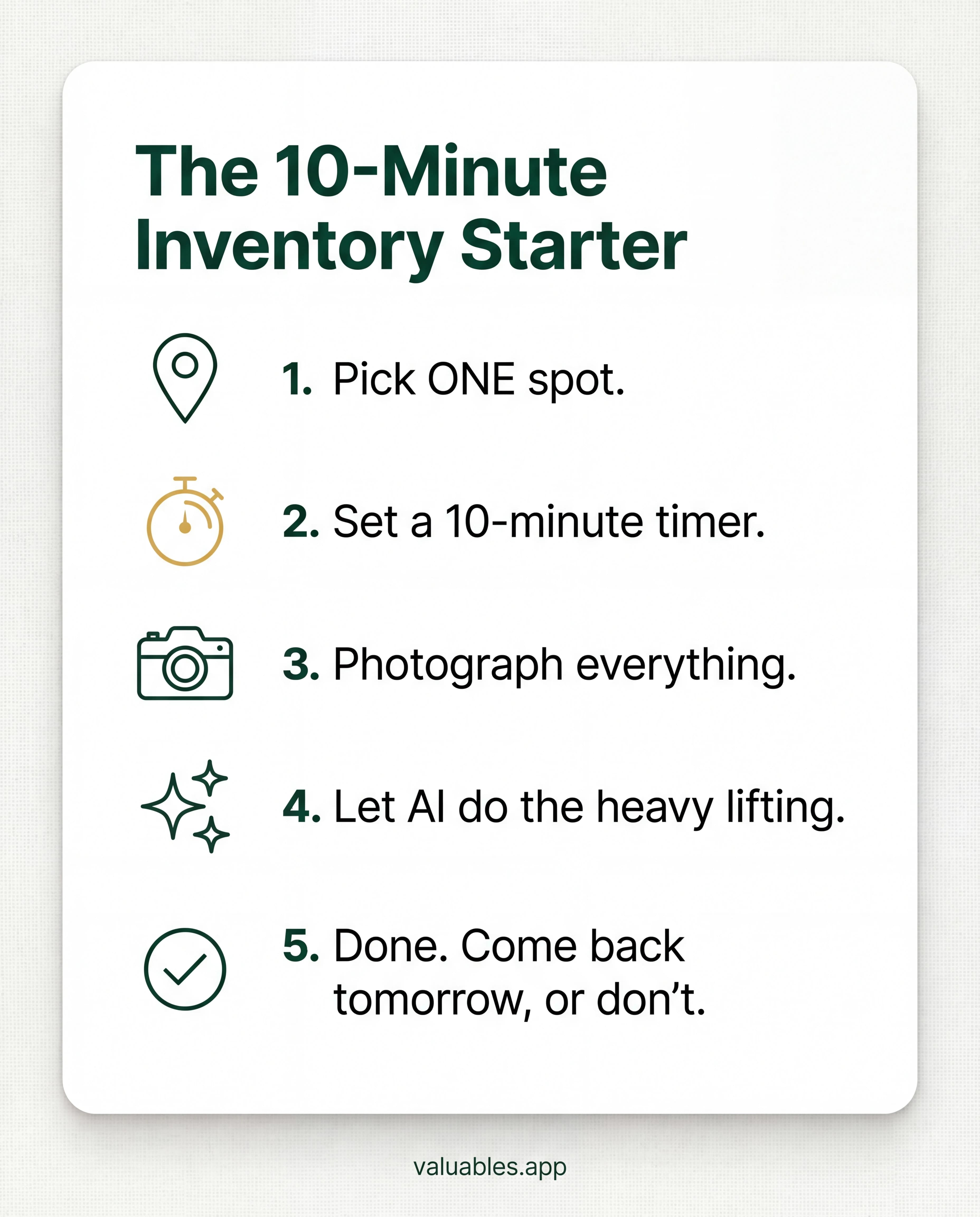
Pick ONE spot. Not a room. A spot. One shelf in a closet, a single storage bin, your nightstand. If deciding feels hard, set a 1-minute timer and pick whatever you're looking at when it goes off.
-
Set a 10-minute timer. When it goes off, you stop. No guilt. No "just one more thing." The timer is your permission to walk away.
-
Photograph everything in that spot. Don't sort, organize, or rearrange. Just capture what's there. This takes about 5-7 minutes.
-
Open the app and upload. Let AI identify items and fill in details. Confirm what looks right, adjust what doesn't. About 2-3 minutes.
-
Done. Tomorrow, pick another spot. Or don't. Either way, what you just captured is permanently saved.
Why this works for ADHD brains specifically#
The scope is tiny, which sidesteps task initiation paralysis. The timer creates external urgency (a dopamine trigger that helps ADHD brains activate). The endpoint is clear and immediate, not "ongoing project with no visible finish line." The app holds all the data permanently, so your brain doesn't need to. And progress is cumulative: skip a week or a month, and everything you've done is still there when you come back.
One shelf a week is 52 shelves a year. The pace doesn't matter. The direction does.
Your Brain Works Differently. Your Tools Should Too.#
Most organization tools ask you to maintain the system through memory, consistency, and sustained attention. For ADHD brains, that's asking the tool to run on the exact cognitive resources you have the least of.
There are several home inventory apps worth trying. Sortly and Itemlist both offer solid inventory features. Valuables App was built specifically around the idea that your household memory shouldn't depend on your working memory. It uses AI to reduce capture effort to a photo, organizes items by real-world location, and works at whatever pace your brain needs. None of these apps require you to finish an inventory to get value from one.
The broader point matters more than any single app recommendation: you don't need to be more organized. You need tools that don't require you to be.
Start with 10 minutes and one shelf. That's all.
Frequently Asked Questions#
Is a home inventory app actually helpful for ADHD, or is this just marketing?#
The core function of a home inventory app (externalizing information that your working memory struggles to hold) follows the same principle behind many established ADHD accommodations: written instructions, calendar apps, and medication reminders all work by moving cognitive load from unreliable internal processing to reliable external structure. Whether a specific app helps depends on its design. The features that matter for ADHD brains are low-friction capture, searchable retrieval, and no requirement for sustained consistency.
I've tried organization apps before and always abandon them. Why would this be different?#
Most organization apps require ongoing maintenance: regular updates, consistent input, daily check-ins. A home inventory app can work differently because each session is self-contained. Take a photo, let AI fill in the details, and it's saved permanently. There's no streak to maintain, no inbox to clear, no system that degrades if you ignore it for three weeks. The inventory grows at whatever pace you can manage.
How long does it actually take to build a useful home inventory?#
Using the 10-minute approach, you can inventory a meaningful portion of your home in a few weeks of casual sessions. Most people start feeling the benefit around 20-30 items, which is when you first search for something and get an immediate answer instead of opening every closet in the house. You never have to "finish." Every item you add has standalone value.
Can a home inventory app help with insurance claims?#
Yes. If your belongings are damaged, stolen, or destroyed, a documented inventory with photos and estimated values makes the claims process significantly faster and more favorable. Without documentation, you're relying on memory to reconstruct everything you owned, and insurers have well-documented strategies for minimizing claims from people who can't provide proof. An inventory app builds that documentation incrementally, so you're prepared without ever facing a single overwhelming "document everything" session.
This article was developed with input from ADHD community discussions and is informed by executive function research from CHADD and ADDitude Magazine. Valuables App is a product of Wishabit, LLC.