Home Inventory for Insurance: The Complete Guide

On this page10 sections
The short version: A home inventory is a documented record of everything you own, organized so that if you ever file an insurance claim, you have evidence of what you lost. Most people don't have one. The ones who do get significantly better claim outcomes. This guide covers what actually happens when you file a claim without documentation, the specific tactics insurers use to reduce payouts, and how to build an inventory that protects you.
What is a home inventory, and why most people get it wrong#
A home inventory is a structured record of your personal property: every item you own, with descriptions, photos, estimated values, and proof of purchase where available. It exists so that if your home is damaged, burglarized, or destroyed, you don't have to rely on memory to prove what was inside.
That definition sounds straightforward. The execution is where people go wrong.
Why "just take a video" isn't enough#
Search Reddit, ask an insurance agent, or read any of the top guides on this topic. You'll hear the same advice: "Walk around your house with your phone and take a video."
It's not bad advice. A video walkthrough is infinitely better than nothing. But it's a floor, not a ceiling. A former adjuster on Reddit's r/homeowners described the standard recommendation: "Open every cabinet and every drawer and walk through with your phone." Good start. Still not enough for a contested claim.
The problem is that video shows you owned something without reliably proving brand, model, purchase date, or value. Adjusters can and do dispute what a video shows: "That could be any handbag." Video also doesn't generate a structured list, so after a loss you're still reconstructing your inventory from memory while scrubbing through shaky phone footage. And the video is often stored on the same device that gets destroyed in the disaster you're insuring against.
A wildfire survivor on r/homeowners learned this firsthand: "Open every drawer and take a picture... down to a god damn spatula. You can't possibly remember every item of clothing... they all add up to thousands."
The gap between "take a video" and "structured, searchable, claim-ready documentation" is where the difference in claim outcomes lives.
What happens when you file a claim without a home inventory#
No insurance company publishes this section. No competing guide covers it honestly. But it's the core of why a home inventory matters.
The claims process most people don't understand#
After a total or major loss, the process works roughly like this:
- You contact your insurer and file a claim.
- They assign an adjuster to your case.
- The adjuster asks for a complete, itemized list of every item you lost. Every book. Every towel. Every spatula.
- For each item, they want: description, brand, model, age, purchase price, and current estimated value.
- For items you can't document, the adjuster assigns their own values.
- Those values are systematically lower than what you paid.
This isn't a conspiracy theory. It's how the system works. The adjuster's job is to settle claims for as little as possible within the policy terms. Documentation shifts leverage from the adjuster to you.
A friend of a fire victim described the aftermath on r/homeowners: "Insurance wanted a list of EVERY item, right down to every book on the shelf, every pillowcase and towel. It took them months."
Real adjuster tactics you should know about#
These come from a first-person account of a 2025 Safeco insurance claim in Missouri, where a tornado destroyed a family's home. Not hypothetical. This is what happened to a real family with a real policy from a real insurer.
Brand relabeling. The insurer listed a Kate Spade purse as a "red leather pouch." Strip the brand name and you can assign a generic replacement value instead of what a Kate Spade bag actually costs. Without a photo or receipt proving the brand, the policyholder couldn't challenge it.
Bulk weighing. All of the family's underwear and bras were weighed together in a plastic bag. The adjuster valued the whole bag as "10 lbs of fluff and fold" at $70 total. No individual items listed, described, or valued.
Arbitrary category caps. The insurer applied a blanket "$100 children's toy allowance" for a household with one child. That child had Build-A-Bear stuffed animals ($25-40 each), custom toys, and an accumulated room of gifts. The $100 cap had no relationship to what was actually lost.
Substitute pricing. Those Build-A-Bear stuffed animals, each costing $25-40 at the store, were priced as "$5 Kohl's Cares" plush. A completely different product at a fraction of the cost.
Aggressive depreciation. Items less than four years old got 70% depreciation. United Policyholders notes that depreciation amounts are "subjective and very negotiable" with no legally binding schedule. But without documentation proving purchase date and condition, the adjuster's number stands.
Documentation demands for destroyed items. Missing items required photographic proof. The items had been carried away by a tornado.
The human cost#
The Missouri tornado victim couldn't afford a lawyer (attorneys in insurance disputes typically take 30% contingency) or a public adjuster (backlogged for months after major storms). She was stuck accepting a fraction of what she lost because she couldn't prove what she owned.
This isn't a scare story. It's a factual account of how the claims process works when you can't prove what was in your home. Every tactic above is one that pre-loss documentation defeats. A photo of the Kate Spade purse with its label visible. A receipt for the Build-A-Bear purchase. A record of the underwear by brand and quantity, not weight. Documentation doesn't guarantee a perfect outcome, but it changes the power dynamic completely.
What to include in your home inventory#
The essential fields for every item#
Not every item needs a serial number and notarized receipt. But every item benefits from basic documentation.
| Field | Why it matters | Example |
|---|---|---|
| Item name and description | Prevents brand relabeling | "Kate Spade Cedar Street Maise satchel, coral" not "red purse" |
| Brand and model | Establishes replacement value | "KitchenAid Artisan 5-qt stand mixer, KSM150PS" |
| Purchase date (approximate) | Limits depreciation claims | "March 2024" |
| Purchase price or receipt | Proves what you paid | "$349.99, receipt from Williams Sonoma" |
| Current estimated value | Sets your baseline | "$280 based on comparable listings" |
| Serial number (if applicable) | Proves ownership, aids theft recovery | "SN: ABC123456" |
| Photos (multiple angles) | Visual proof of condition and brand | Front, back, label, any existing damage |
| Location in home | Speeds up room-by-room claims | "Kitchen, upper cabinet left of stove" |
For items worth over $500, spend the extra two minutes: photograph the label or serial number, attach the receipt, note the purchase date. These get the most scrutiny during a claim, and they're where documentation pays off the most.
The categories people always forget#

Some categories get overlooked in nearly every home inventory. Collectively, they represent thousands of dollars.
Clothing. "Everyone forgets clothes when it comes to insurance." A wardrobe is worth $5,000 to $15,000 at replacement cost. The Insurance Information Institute recommends tallying clothing by type: "5 pairs of jeans, 3 pairs of sneakers, 12 dress shirts." You don't need to photograph every sock. You do need a count.
Children's items. Toys, gear, car seats, strollers, accumulated gifts. Easily $2,000 to $5,000 for a family with young kids. Remember the $100 toy cap from the tornado case.
Kitchen items. Most kitchens hold $3,000 to $8,000 in appliances, cookware, and kitchenware. For a detailed room-by-room breakdown with dollar figures, see our guide on what to include in a home inventory.
Tools and garage items. Power tools, lawn equipment, garden supplies, sporting goods. Frequently stored in places nobody thinks to inventory.
Linens and towels. Cheap individually. Replacing every towel, sheet set, blanket, and pillow in a household runs hundreds of dollars.
Books, media, and hobby supplies. Low individual value, high collective value. A bookshelf with 200 books at $15 average is $3,000.
How to create a home inventory, step by step#
Step 1: Choose your method#
| Method | Effort | Claim readiness | Best for |
|---|---|---|---|
| Video walkthrough | Low | Low | Absolute minimum. Better than nothing. |
| Spreadsheet (Excel or Google Sheets) | Medium-High | Medium | People who want full control over their data |
| Dedicated inventory app | Medium | High | Structured, claim-ready data with minimal friction |
| Professional appraisal | High (cost) | Very High | High-value items: jewelry, art, antiques, collectibles |
Most people will get the best results from an app, supplemented by professional appraisals for their highest-value individual items.
Step 2: Start with one room#
Don't try to inventory the entire house in one session. That's how the project stalls permanently. Start with the room that holds the most valuable items (usually the primary bedroom or living room). Finishing one room creates momentum and gives you something tangible to build on.
Step 3: Work room by room#
One room at a time:
- Kitchen: Appliances (large and small), cookware, dishes, glassware, cutlery, gadgets, pantry staples
- Living room: Furniture, electronics, decor, books, media, lamps, rugs
- Primary bedroom: Furniture, clothing, jewelry, watches, personal items, bedding
- Additional bedrooms: Same categories, plus children's items where applicable
- Bathrooms: Toiletries, small appliances, linens. Often forgotten, collectively worth more than you'd guess.
- Home office: Computers, monitors, peripherals, supplies, desk furniture
- Garage, basement, attic: Tools, seasonal items, storage boxes, sporting goods, lawn equipment
- Outdoor spaces: Patio furniture, grill, garden tools, play equipment
For each room, open drawers, closets, and cabinets. The items you can't see are the ones you'll forget to claim.
Step 4: Document high-value items in detail#
For anything worth over $500: take multiple photos (including the label or serial number), attach the receipt if you have it, note the purchase date, and record the current estimated value. These items get the most scrutiny during a claim and offer the most leverage when properly documented.
For items over $2,500 (jewelry, fine art, musical instruments, collectible watches), consider a professional appraisal. Standard homeowners policies often cap coverage for individual items at $1,000 to $2,500 per category. You may need a scheduled item endorsement (also called a rider or floater) to cover the full value. The appraisal serves double duty: it proves value for the rider and provides documentation for a future claim.
Step 5: Store it safely (and off-site)#
Cloud storage is the only truly disaster-proof option. If your home is destroyed, anything stored inside it goes too, including that USB drive in the fireproof safe (which is rated for documents, not electronics, and only for a limited time).
Practical approach:
- Use an app with automatic cloud backup as your primary record.
- Export a PDF or CSV copy and email it to yourself once a year.
- Store a printed copy in a safe deposit box if you want a physical backup.
- Never store your only copy in the home you're insuring.
Step 6: Keep it updated#
An inventory is only useful if it reflects what you currently own. Review annually at minimum, update after major purchases, and update after major life events (moving, renovating, inheriting items).
The reality about updating: spreadsheets decay because opening a spreadsheet, finding the right row, and entering data has just enough friction to prevent most updates from happening. Apps that let you photograph an item and add it in under a minute get maintained. Spreadsheets mostly don't. Pick the method you'll actually keep up with, not the one that sounds most thorough.
Room-by-room home inventory checklist#
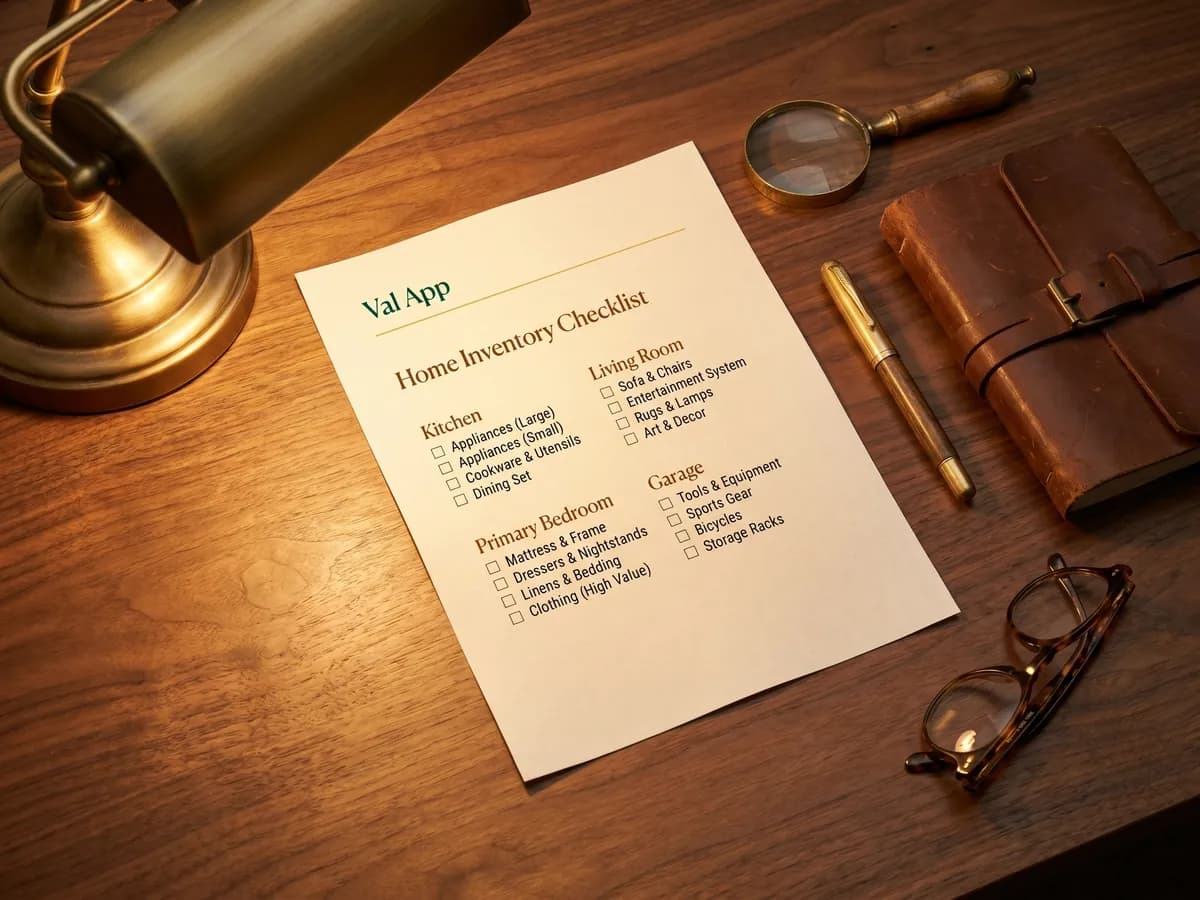
Use this as a reference when working through your home. You don't need to document everything on day one. Start with the categories that hold the most value in your household and expand from there.
Kitchen: Refrigerator, stove or range, dishwasher, microwave, stand mixer, blender, food processor, coffee maker or espresso machine, toaster, cookware sets, baking sheets and pans, cast iron skillets, knife sets, dishes and serving ware, glassware, silverware or flatware, small appliances (air fryer, Instant Pot, rice cooker), specialty items (bread maker, ice cream maker)
Living room or family room: Sofa, chairs, coffee table, end tables, entertainment center, television, soundbar or speakers, gaming consoles, streaming devices, lamps, rugs, artwork, decorative items, bookshelves and books, media collections
Primary bedroom: Bed frame and mattress, dressers, nightstands, clothing (count by category), shoes, outerwear, jewelry, watches, handbags, bedding sets, personal electronics (tablet, e-reader), keepsakes
Children's rooms: Bed and furniture, clothing (count by size or season), toys and games, books, electronics (tablet, console), sports equipment, musical instruments, baby gear (crib, stroller, car seat), collectibles (trading cards, LEGO sets)
Home office: Desktop computer or laptop, monitors, keyboard and mouse, headphones, webcam, printer or scanner, desk and chair, filing cabinet, supplies
Bathrooms: Hair dryer, flat iron or curling iron, electric razor, towels and linens, toiletries (collective estimate is fine)
Garage, basement, attic: Power tools (drill, saw, sander), hand tools, lawn mower, snow blower, leaf blower, generator, bicycles, sports gear (golf clubs, ski equipment, camping gear), holiday decorations, stored seasonal clothing, storage bins (note contents)
Outdoor: Patio furniture, grill, garden tools, hoses, play equipment, planters
Understanding insurance depreciation, and how to fight it#
What is depreciation?#
Depreciation is the insurer's estimate of how much value your item has lost since you bought it. There's no universal schedule for it. United Policyholders explains that depreciation amounts are "subjective and very negotiable" with "no uniform or legally binding schedule" for how much insurers can reduce your payout.
That subjectivity cuts both ways. Without documentation, the adjuster's depreciation estimate goes unchallenged. With documentation, you have something to push back with.
Actual cash value vs. replacement cost#
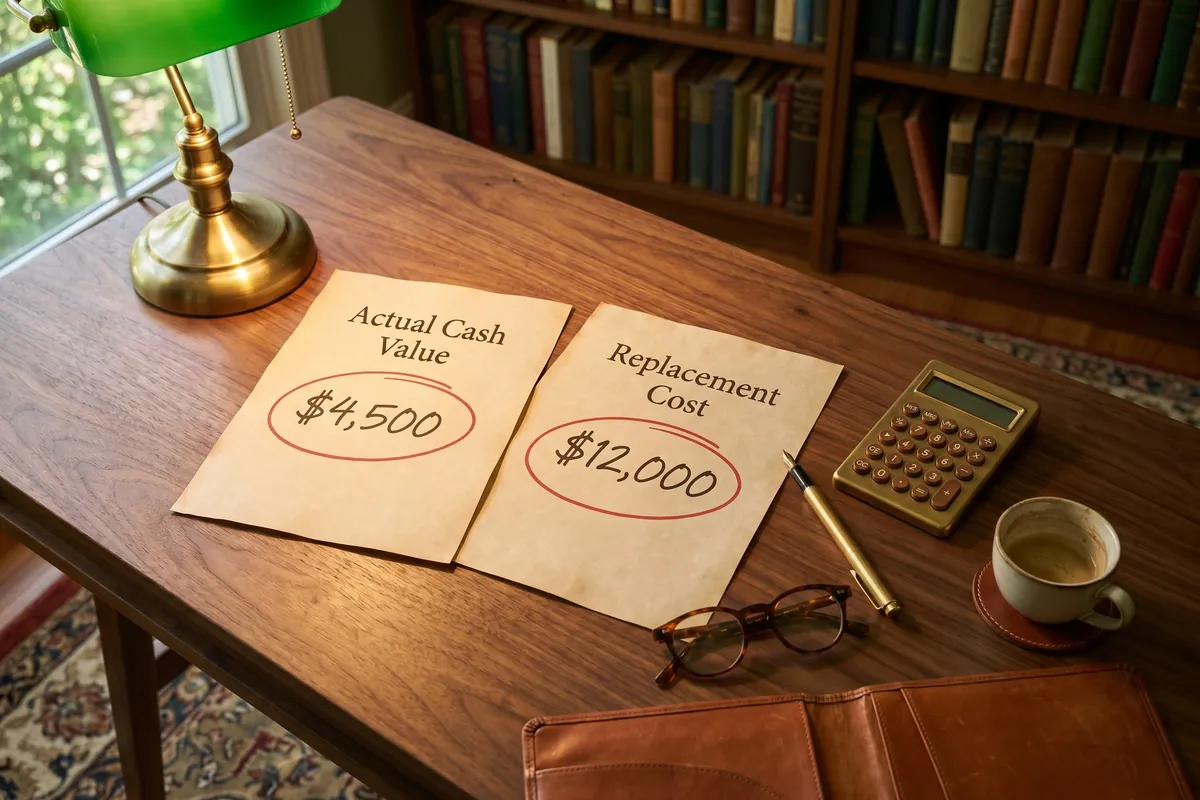
Two policy types determine how your claim gets paid.
Actual Cash Value (ACV) pays the depreciated value of your items. A couch you bought for $2,000 four years ago might pay out $600 under ACV, depending on the adjuster's depreciation calculation.
Replacement Cost Value (RCV) pays what it costs to buy a comparable item today. That same couch would pay $2,000 (or whatever a comparable couch costs now). RCV policies cost more in premiums but pay dramatically more in claims.
If you have an ACV policy, upgrading to RCV is one of the most impactful changes you can make to your homeowners or renters insurance. The premium difference is modest compared to the claims difference.
One catch with RCV: the insurer typically pays the ACV amount first, then reimburses the rest after you replace items and submit receipts. United Policyholders notes that once you replace everything and submit receipts, you should be fully reimbursed and "the excessive depreciation won't matter." But you need cash flow to replace items before getting that balance, which is a real hardship after a major loss.
How documentation defeats excessive depreciation#
Back to the tornado case: 70% depreciation on items less than four years old is aggressive, but it's defensible when the policyholder can't prove purchase date or condition. With a receipt showing the purchase was two years ago, a photo showing good condition, and a record of the specific brand and model, the policyholder has concrete evidence to push back.
Depreciation is negotiable. Documentation is your leverage.
How to challenge a depreciation calculation#
If your adjuster's depreciation seems excessive:
- Ask for a line-by-line depreciation breakdown. You're entitled to see how each item was depreciated.
- Provide purchase dates and receipts to counter age-based depreciation.
- Show photos of item condition to counter wear-and-tear assumptions.
- Reference current retail prices for comparable items (screenshot the product page).
- Know that you can push back. Depreciation percentages aren't fixed formulas set by law. They're estimates, and estimates are negotiable.
How to know if you're underinsured#
The coverage gap most homeowners miss#
Standard homeowners policies typically cover personal property at 50 to 70 percent of dwelling coverage. For a $400,000 home, that's $200,000 to $280,000 in contents coverage. Most people assume that's plenty.
Many find out it isn't. One app user put it plainly: "In using this app, I've realized that I greatly underestimated the value of my belongings." Another: "I soon learned I was underinsured."
A standard two-bedroom home holds roughly $70,000 in personal property at replacement cost. Larger homes, $100,000 to $150,000 or more. But those are averages. A household with a watch collection, a well-equipped kitchen, or extensive wardrobes can blow past standard coverage limits easily.
Scheduled items and riders#
Standard policies often cap coverage for specific categories: $1,000 to $2,500 for jewelry, $2,500 for electronics, $2,000 for silverware. If any single item or collection exceeds those caps, you need a scheduled item endorsement (also called a rider or floater).
A rider costs extra premium but gives you agreed-upon coverage for the specific item, typically with no deductible and broader protection than the base policy. It requires a professional appraisal, which doubles as claim documentation.
Items that commonly need scheduling: engagement rings and fine jewelry, watches over $2,500, fine art, musical instruments, collectibles (coins, stamps, trading cards), fur coats.
The best tools for creating a home inventory#
Dedicated home inventory apps#
The most effective approach for most people. Several options exist with different strengths.
The NAIC offers a free home inventory app that covers the basics: photos, descriptions, barcode scanning, and export. It's functional and costs nothing.
Sortly and Itemlist both offer clean organization by room and location with photo attachments. Under My Roof has a following among insurance-conscious users, with one wildfire survivor noting: "After losing a small cabin to wildfire, my insurance company wanted a detailed inventory list before paying out on the contents portion of the policy."
Val App adds AI-assisted item capture: photograph an item and the app identifies it, pulls in details, and estimates replacement value, which reduces the manual data entry that causes most inventories to stall. It also organizes items by real locations (rooms, closets, storage units), matching how insurance claims are actually filed.
The best app is the one you'll actually use. Try a couple and see which workflow sticks.
Spreadsheet templates#
Spreadsheets work for people who want full control over their data. United Policyholders offers a free home inventory spreadsheet template that covers the essential fields. Google Sheets has the advantage of automatic cloud backup.
The trade-off is friction. Updating a spreadsheet takes enough steps that most people stop maintaining it within a few months. If you go this route, set a quarterly calendar reminder.
Video and photo documentation#
If a full structured inventory feels like too much right now, a video walkthrough is a legitimate starting point. The key is doing it properly:
- Walk slowly through every room.
- Open every drawer, closet, and cabinet.
- Narrate as you go: name items, note brands, mention approximate values.
- Film labels, serial numbers, and model numbers on high-value items.
- Store the video in the cloud, not just on your phone.
Over time, migrate toward a structured format. The video gives you a baseline; a proper inventory gives you leverage.
What to look for in a home inventory app#
If you go the app route, here's what matters most: cloud backup (your inventory has to survive the same event that destroys your home), photo attachment per item (visual documentation is the strongest claim evidence), room-by-room organization (claims are filed by room, so your inventory should match), export to PDF or CSV (for sharing with your insurer), offline access (basements and garages often have no Wi-Fi), reasonable data security (your inventory is a map of everything valuable you own), and low-friction updates (if adding an item takes more than a minute, you'll stop).
After a loss: how to use your inventory#

Filing a claim with an inventory#
If you have a pre-loss inventory, the claims process looks very different:
- Contact your insurer and report the loss.
- Request the adjuster's claim form and format requirements.
- Export your inventory and map it to the insurer's format. Most apps export to PDF or CSV.
- Submit room-by-room documentation with photos, descriptions, and values.
- Review the adjuster's line-item response. Compare their values to yours.
- Challenge any discrepancies with your documentation: photos, receipts, purchase dates.
An inventory doesn't guarantee a perfect outcome. But it turns the process from "try to remember everything while grieving" into "review the documentation you already have."
If you don't have an inventory (what to do now)#
If you're reading this after a loss with no pre-existing inventory, you're not starting from zero. There are ways to reconstruct partial documentation:
Amazon order history. Go order by order. Many household items were purchased online and the records still exist.
Email receipts. Search your email for order confirmations from major retailers.
Credit card statements. Your bank can provide statements showing purchase amounts and merchants.
Photos. Search your phone's photo library for images of your home. Birthday parties, holiday gatherings, and video calls often capture rooms and possessions in the background.
Friends and family. Ask people who've visited your home for any photos they might have.
Social media. Your own posts and tagged photos may show rooms, items, possessions.
This is painful, slow work. It won't produce as strong a record as pre-loss documentation. But it's significantly better than submitting a claim from pure memory, and every item you can document is one the adjuster can't unilaterally undervalue.
Frequently asked questions#
What is a home inventory for insurance?#
A documented record of everything you own, with descriptions, photos, values, and proof of purchase. Its insurance purpose is to give you evidence of what you lost when filing a claim, so the insurer can't just assign their own values to your belongings.
How do I create a home inventory?#
Start with one room. Pick a method (app, spreadsheet, or video as a minimum). For each item, record a description, brand or model, approximate value, and take a photo. Work room by room over days or weeks. Store the finished inventory in the cloud. Update after major purchases and at least once a year.
What should be included in a home inventory checklist?#
Everything you'd need to replace if your home were destroyed. That includes the obvious (electronics, jewelry, furniture) and the overlooked (clothing, kitchen items, children's toys, tools, linens, garage contents). For a detailed room-by-room breakdown, see our guide on what to include in a home inventory.
Is there a free home inventory app?#
Yes. The NAIC offers a free app with photo capture, barcode scanning, and export. Several other apps offer free tiers with limited item counts. For most people, a paid app with unlimited items and cloud backup is worth the modest subscription.
How often should I update my home inventory?#
Once a year at minimum. More practically: after any significant purchase, after a move, and after any renovation or major life event. The goal is that your inventory roughly matches your current household at all times.
What happens if I file a claim without a home inventory?#
You'll be asked to produce a complete list of everything you lost, from memory, while dealing with the aftermath of whatever happened to your home. The adjuster will assign their own values to items you can't document. As the Missouri tornado case shows, those values can be aggressively low: brand items relabeled as generics, categories capped at arbitrary amounts, depreciation applied without reference to actual purchase dates.
Does a video walkthrough count as a home inventory?#
It's better than nothing and worse than a structured inventory. Video proves you owned items but doesn't reliably establish brand, model, value, or purchase date. For a quick baseline, it works. For a contested claim, you need structured documentation.
How detailed does my home inventory need to be?#
For items under $50, a category count is fine ("approximately 30 books," "12 towels"). Over $50, individual documentation with a description and photo. Over $500, add serial number, receipt, and detailed photos. Over $2,500, consider a professional appraisal and a scheduled item rider on your policy.
Do renters need a home inventory?#
Yes. Renters face the same risks (fire, flood, theft, pipe bursts) with less insurance coverage and often zero documentation. A renter on r/personalfinance dealing with a fecal water flood said: "I'm getting ready to inventory now so I can have a number in mind for the claim." Pre-loss documentation would have made that far easier.
What's the difference between actual cash value and replacement cost?#
Actual cash value (ACV) pays the depreciated value of your items: what they're worth today, accounting for age and wear. Replacement cost value (RCV) pays what it costs to buy a comparable new item. RCV policies cost more in premiums but pay dramatically more in claims. If you're on ACV, ask your agent about upgrading. The premium difference is usually modest relative to what you'd get back on a claim.
This guide was researched using public insurance claim data, consumer advocacy resources from United Policyholders, depreciation guidance from United Policyholders, the Insurance Information Institute, NAIC consumer resources, and firsthand accounts shared in online communities including r/Insurance, r/homeowners, r/personalfinance, and r/declutter. Val App is a home inventory product built by Wishabit, LLC. We build this software and write about the home inventory category with the goal of being genuinely useful, including recommending competitor products and free resources where they serve readers well.