The Five Box Method: Keep, Store, Sell, Donate, Trash

On this page8 sections
The short version: The five box method is a simple way to declutter: every item you pick up goes into one of five boxes. Labels vary; this guide uses Keep, Store, Sell, Donate, and Trash. You work through one small area at a time, make a call on every single item, and then empty the boxes quickly, because a Donate bag that sits in the hallway for a month is just clutter in a new spot. It works because it turns "what do I do with all this?" into one small decision at a time.
What is the five box method?#
The five box method gives every item in a room a destination. You set out five boxes, pick up one thing at a time, and put it in the box that matches what will happen to it next. APDO, the UK association of professional declutterers and organisers, describes the method in its guide to getting started with one firm rule: "You have to deal with every single item by placing it in one of the boxes."
The labels change from source to source. APDO's version uses Trash, Give Away, Keep, Relocate, and Recycle. This guide uses Keep, Store, Sell, Donate, and Trash, because those five match what usually happens to the things in a closet, a garage, or a spare room. If a different set fits your home better, use it. What matters is that every box ends in something you actually do.
What goes in each box?#
| Box | What goes in it | What happens next | Suggested deadline |
|---|---|---|---|
| Keep | Things you use or love, including things that belong in another room | Back where they live | Same day |
| Store | Seasonal gear, things you'll need later, and keepsakes you've chosen to keep | A labeled bin, out of your daily space | This week |
| Sell | Things in good shape that might be worth the time to list | Price check, photos, listing | Listed in two weeks; gone by a date you pick |
| Donate | Usable things you don't need and won't sell | Drop-off or pickup | This week |
| Trash | Broken, worn out, or past use (anything leaving through recycling or the garbage) | Recycling first, garbage last | Same day |
Many guides skip the deadline column, but it's the part that keeps the job finished. Clutter comes back when the boxes sit around, so give each one an end date before you start.
How do you run a five-box session?#
- Pick one small area. One closet shelf, one drawer, the floor of the hall closet. A finished shelf beats a half-sorted room.
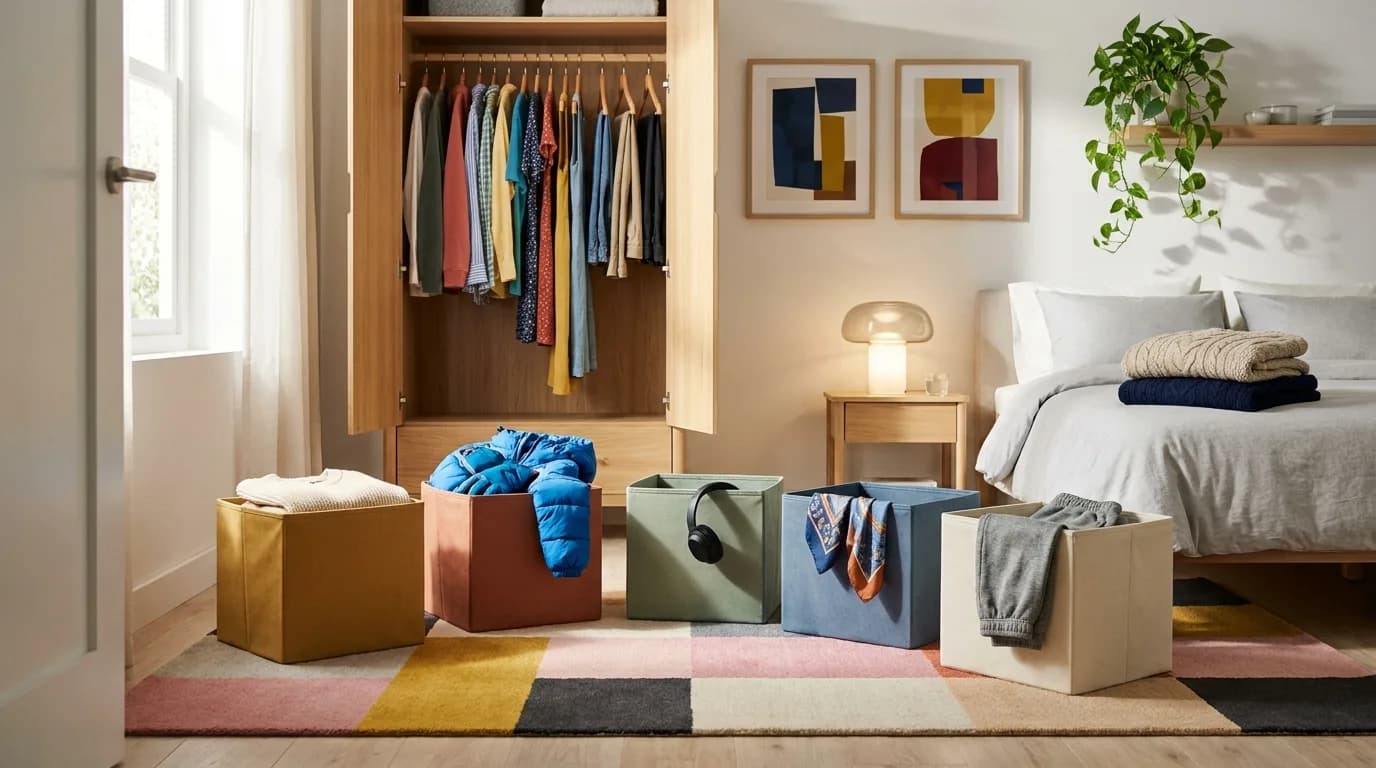
- Set out five boxes or bags. Canvas bins, laundry baskets, or shopping bags all work. Label them so you don't have to remember which pile is which.
- Pick up one item at a time. Decide, drop it in a box, and pick up the next one. Don't dump everything on the floor first; that's how a ten-minute shelf turns into a three-hour mess. If something belongs in another room, it goes in Keep, and you carry it back when you're done.
- Ask the same few questions every time. Have I used it in the last year? Would I buy it again today? Does it fit, work, and have all its parts? These are prompts, not a score. If most of the answers are no and it isn't a keepsake, think twice before it goes in Keep.
- Stop when the area is done. Put the Keep items away and take out the Trash right away. Put Store, Sell, and Donate on your calendar.
As APDO puts it, "Some projects take an hour, others days or even weeks." The method is the same either way, and a short session on one shelf still counts as a finished session.
How do you decide which box something goes in?#
Keep and Trash are usually easy. The middle three are where people get stuck.
Store or Keep? Keep is for things you use now, wherever they belong. Store is for two kinds of things. The first is things you'll need again, just not this season, like the ski jacket in April or the holiday dishes. For those, the test is whether you can say when you'll next need them; if you can't, they may belong in Sell or Donate. The second is keepsakes you've decided to keep, like the box of letters you'll never throw out. They don't need a next use. They just need a labeled bin instead of space on a shelf you use every day.
Sell or Donate? Don't stop the session to research prices. If something might be worth selling, put it in Sell and keep going. Afterward, look up everything in the Sell box at once: search a resale site for the same brand and model and see what similar listings are asking, or better, what they actually sold for. Then weigh that against the time it takes to photograph it, list it, answer questions, and ship it. A camera body or a designer jacket usually earns its listing time. A stack of paperbacks usually doesn't, so it moves to Donate.
Donate or Trash? If someone could use it as it is, donate it. If it's stained, broken, or missing parts, charities generally don't want it either. For clothes in that state, look for textile recycling before the garbage. According to the EPA's textile data, U.S. landfills received 11.3 million tons of textiles in 2018.
What does a session look like? A sample closet shelf#
| Item | Box | Why | Next step |
|---|---|---|---|
| Merino sweater, worn weekly | Keep | Used all the time | Back on the shelf |
| Ski jacket | Store | Needed in December, not now | Labeled bin with the gloves |
| Canon mirrorless camera, unused for three years | Sell | Good condition, worth the listing time | Check similar listings, list this week |
| Two scarves, tags still on | Donate | Never worn; someone else will wear them | Drop off on Saturday |
| Sweatpants with holes | Trash | Worn out | Textile recycling bin |
Five items, five different outcomes, about ten minutes to sort. Pricing, listing, and the drop-off come after.
How do you empty the boxes?#
Keep: Put everything back today, in the spot where you'd look for it first.
Store: Use bins you can label, and write down what's inside. A bin labeled "winter" doesn't help in July when you're looking for one specific pair of gloves. A list of what's in it does.
Sell: Take clear photos with the brand label or model number showing, since buyers search by brand and model. Price it from similar listings, not from what you paid. If it's a phone, tablet, or laptop, wipe your personal data first. Then pick a date, such as a month out. If it hasn't sold by then, either donate it, decide on purpose to keep it, or lower the price once and give it one more week before it goes to Donate. What it shouldn't do is sit in the Sell box indefinitely.
Donate: Drop it off this week. In the U.S., if you plan to deduct what you give, keep a list of the items and their condition; IRS Publication 526 says clothing and household items must be "in good used condition or better."
Trash: Recycle what you can. The EPA says lithium-ion batteries, and devices that contain them, should not go in household garbage or recycling bins. Its electronics donation and recycling page points to places that take old phones and gadgets.
Why does clutter come back, and how do you stop it?#
Decluttering often comes undone after the sort, not during it. The Donate bag rides around in the car for a month, the Sell pile becomes a permanent corner of the guest room, and new things arrive faster than old ones leave. Two habits help.
The first is the deadline column above. The second is knowing what you already own. It's easy to buy a second phone charger or another black sweater when you can't see the one you have, and duplicates are how a shelf you cleared in spring fills up again by fall. Our guide to the "didn't know" rule shows how to find what's been forgotten and stop buying what you already own. If keeping track of things is hard for you in general, our ADHD home organization guide has a ten-minute way to start a record of what you own, one shelf at a time.
You can run the five box method with a notebook, a spreadsheet, or an app like Sortly or Val App. In Val App, each item can carry a plan (Keep, Store, Sell, Donate, or Trash), and filtering by plan shows what's still waiting to leave, like everything marked Sell. When you're ready to sell something, Val App can show what similar items are listing for and list it on eBay from the item's page.
Frequently asked questions#
What are the five boxes in the five box method?#
A common set is Keep, Store, Sell, Donate, and Trash. Some versions use different labels, such as Relocate for things that belong in another room; in this guide, those go in Keep and get carried back when the session ends. Pick the five that match what really happens to things in your home, and give each box a deadline.
What if I can't decide which box something goes in?#
Put it in the box you lean toward and move on, so one item doesn't stall the session. If it might be worth money, Sell is a fine holding spot, since you'll check prices after the session. If you're torn between keeping it and letting it go, and it isn't in your way, store it in a bin with a date on the label and decide again when that date comes.
What if something in the Sell box doesn't sell?#
Pick a cutoff date when you list it, such as a month out. When the date comes, donate it, decide on purpose to keep it, or lower the price once and set a final week before it goes to Donate. What matters is making a decision, so the Sell box doesn't become a permanent corner of the room.
Should I sell or donate things I don't need?#
Check what similar items have sold for, then weigh that against the time it takes to list and ship them. Brand-name electronics, cameras, and designer clothing are often worth the effort. Everyday items in good shape may not earn enough to justify the listing time, so donating them is usually simpler.
This article draws on APDO's guide to getting started with decluttering, IRS Publication 526, and EPA guidance on textiles and electronics donation and recycling. Val App is a home inventory product built by Wishabit, LLC. We build this software and also write about the category honestly, including recommending competitor products and free resources where they serve readers well.
Question 1 of 5
Find your starting point
Five quick questions, then one small first step to try in Val.
What brought you here today?
Related stories
Too Much Stuff? The "Didn't Know" Decluttering Rule
Too much stuff? The "didn't know" decluttering rule says what you forgot you owned can go. How to use it, what to keep, and how to avoid buying duplicates.

Home Inventory App vs Spreadsheet: Which Should You Use?
A spreadsheet is free, flexible, and opens anywhere. An app keeps photos, details, and locations together with less setup. When to use each, or both together.
ADHD and Home Organization: Why a Home Inventory App Might Be the Tool You've Been Missing
Most organization tools weren't built for ADHD brains. A home inventory app externalizes the work your memory struggles with. What you own, where it is, what matters.