Too Much Stuff? The "Didn't Know" Decluttering Rule

On this page6 sections
The short version: The "didn't know" decluttering rule says that if you come across something you didn't know you owned, you have permission to let it go. It's a fast way to shrink a pile of stuff without agonizing over each item. It has two limits: some forgotten things still matter (documents, keepsakes, safety gear), and it only works on what you happen to find. The fix for both is to look on purpose, one storage spot at a time, and to keep a list of what you keep so you're less likely to buy things you already own.
What is the "didn't know" decluttering rule?#
The "didn't know" rule comes from The Minimalists (Joshua Fields Millburn, Ryan Nicodemus, and T.K. Coleman), who talk through it in a short video as a "new minimalism rule for getting rid of material possessions right now." Stylist's write-up puts it in one line: "if you find something that you didn't know you had, get rid of it." The thinking is that if you forgot you owned something, you probably weren't using it or missing it.
The rule is useful because it skips the hardest part of decluttering, which is deciding whether each thing might come in handy someday. You can argue about "someday" all afternoon, but "I didn't know I had this" is just a fact.
Do I own too much stuff?#
There's no number that answers this, but a few signs come up again and again:
- You buy things you already own. A second rain jacket, another pair of wireless earbuds, a tool set you already had, because the first one was somewhere you couldn't find or didn't remember.
- You can't find things when you need them, even things you know you have.
- Some storage never gets opened. The top shelf of the hall closet, the bins under the bed, the boxes in the garage that came with you from the last move.
- Putting things away takes longer than using them, because every drawer and shelf is full.
If two or three of those sound familiar, the "didn't know" rule is a good place to start, because it goes straight for the stuff those signs point to.
How do you use the rule without regret?#
Forgetting about something isn't always a sign you don't need it, so we'd add a few exceptions of our own. Before anything leaves the house, check it against this list:
- Documents. Tax returns, passports, birth certificates, warranties, and titles are easy to forget and hard to replace. Keep them, and move them somewhere you'll remember.
- Keepsakes. Letters, photos, a grandparent's watch. Forgetting about a keepsake doesn't mean it stopped mattering. Keep it, or decide about it on a separate day.
- Safety and emergency gear. A fire extinguisher, a first aid kit, flashlights. You may rarely use these, but they matter when you do. Keep them easy to reach, and check them now and then so they're ready.
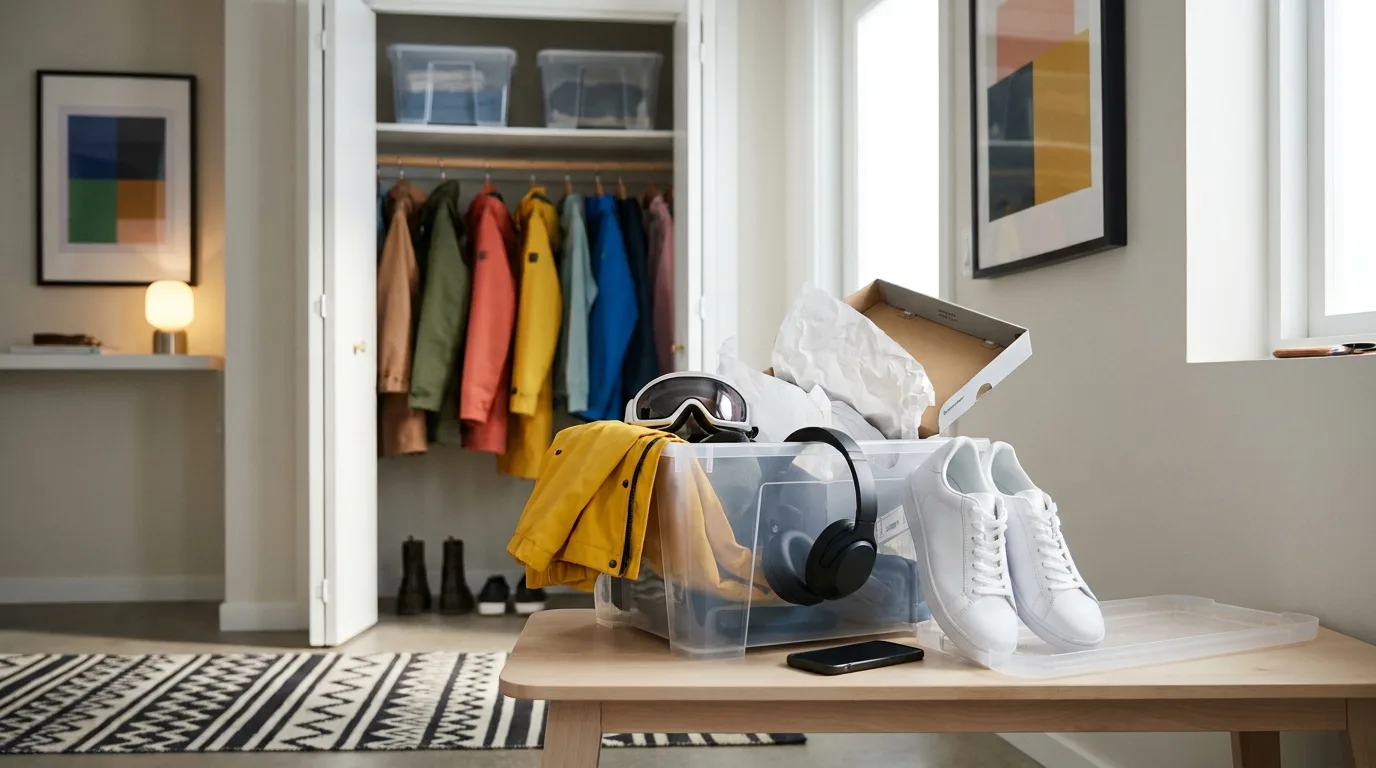
- Seasonal things. The ski goggles you forgot about in July are still the ski goggles you'll want in January. Store them in a labeled bin.
- Other people's things. The rule applies to what's yours. Ask before letting go of a partner's, roommate's, or kid's stuff.
Everything else you forgot you owned is fair game. It doesn't have to go in the trash, either: you can sell it, give it to someone who'll use it, donate it, or recycle it.
What's the catch with the "didn't know" rule?#
You can only apply the rule to what you find, and you usually find forgotten things by accident, while looking for something else. The drawers you open every day never surprise you, but the bins at the back of the closet do. So the stuff the rule is best at clearing out is the stuff you're least likely to come across.
The answer is to go looking on purpose. Pick one storage spot (a closet shelf, an under-bed bin, one box from the garage), open it, and go through everything inside. For each item, ask one question: did I remember owning this? Anything you didn't remember goes into a "decide" pile, checked against the exceptions above. Our guide to the five box method covers what to do with that pile.
A sample sweep: one hall closet shelf#
| Item | Did you remember owning it? | Decision | Next step |
|---|---|---|---|
| A second rain jacket | No | Let it go | Donate |
| Old iPhone in a shoebox | No | Let it go | Back up, erase, then recycle or sell |
| Ski goggles | Yes, seasonal | Keep | Labeled bin with the other ski gear |
| Flashlight with dead batteries | No | Keep | New batteries, then store it where you can reach it |
| Sneakers still in the box | No | Keep | Start wearing them |
Forgetting something doesn't mean it has to go. The flashlight stays because it's safety gear, and the sneakers stay because they fit and you'd wear them now. The rule gives you permission to let things go; it doesn't require it.
Wipe old phones and laptops before they leave the house. The FTC's guide to removing your personal information from a phone opens with this advice: "Before you trade in, sell, give away, or recycle your phone, remove your personal information." Its steps are to back up the phone, take out any SIM and SD cards, and erase it. For an iPhone, Apple's checklist for selling or giving away your device also covers signing out. The EPA's electronics donation and recycling page points to places that take old devices.
How do you keep it from coming back?#
Clearing out forgotten things feels great. A few months later, though, the closet can fill up again, partly because new things keep arriving and partly because the things you kept are out of sight again. Three habits help.
Know what you kept. Write down or photograph what goes back into each bin and on each closet shelf. An up-to-date list makes it easier to find what you own and avoid buying duplicates: before buying another rain jacket, pair of earbuds, or tool set, check it. You don't need to cover the whole house to get this benefit. Start with storage, since that's what gets forgotten, and our guide to what to include in a home inventory can help if you want to go further.
One in, one out. When something new comes in, something similar goes out. A new jacket means an old one goes in the Donate bag.
Repeat the sweep. Go through one storage spot each season. Twenty minutes on one shelf or bin is plenty, and it catches forgotten things before they pile up.
You can keep that list in a notebook, a spreadsheet, or an app like the NAIC's free Home Inventory app or Val App. In Val App, a home inventory app for iPhone, you photograph things and file them under the room or box where they live, so a quick search shows what you've saved and where it is. When a sweep turns up something you don't need, you can give it a plan like Sell or Donate, check what similar items are listing for, and list it on eBay from the item's page.
Frequently asked questions#
What is the "didn't know" decluttering rule?#
It's a rule from The Minimalists: if you find something you didn't know you owned, you can get rid of it, because you weren't using it or missing it. It's a quick way to let go of things without debating whether they might be useful someday.
Does the "didn't know" rule apply to sentimental items?#
It doesn't have to. Keepsakes, important documents, safety gear, and seasonal items are common exceptions. Forgetting about something doesn't mean it stopped mattering, so set those aside and decide about them separately.
How do I stop buying things I already own?#
Keep a list or photos of what you own and where it lives, and check it before you buy. Duplicates often happen because the first one was out of sight, not because you needed a second.
How often should I declutter?#
There's no fixed schedule. A short sweep of one storage spot each season catches forgotten things before they pile up, and it's much easier than one big purge a year.
This article draws on The Minimalists' video on the "didn't know" rule, Stylist's explainer on the method, the FTC's guidance on removing personal information from a phone, Apple's device checklist, and the EPA's electronics donation and recycling page. Val App is a home inventory product built by Wishabit, LLC. We build this software and also write about the category honestly, including recommending competitor products and free resources where they serve readers well.
Question 1 of 5
Find your starting point
Five quick questions, then one small first step to try in Val.
What brought you here today?
Related stories
The Five Box Method: Keep, Store, Sell, Donate, Trash
The five box method for decluttering sorts every item into Keep, Store, Sell, Donate, or Trash. How to run a session, pick a box, and set deadlines to finish.

Home Inventory App vs Spreadsheet: Which Should You Use?
A spreadsheet is free, flexible, and opens anywhere. An app keeps photos, details, and locations together with less setup. When to use each, or both together.
ADHD and Home Organization: Why a Home Inventory App Might Be the Tool You've Been Missing
Most organization tools weren't built for ADHD brains. A home inventory app externalizes the work your memory struggles with. What you own, where it is, what matters.